Adding Filter Rule Definitions

Click Add on the Filter dialog box to access the Rule Definition dialog box. You can also double-click on an existing rule to open the Rule Definition dialog box.

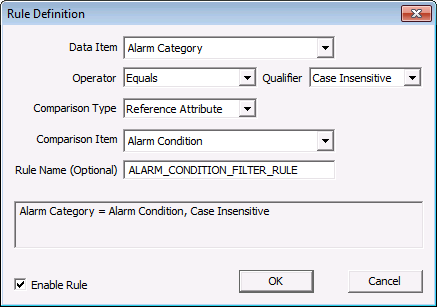
Use the Rule Definition dialog box to create a filter logic rule to assist in grouping items together, comparing items against each other, or any combination of filter logic to assist with filtering the selected data.

Rule Definition

Rule Definition

The properties on the Rule Definition dialog box are described below.

Parameter Description

Data Item

Select a reference Attribute (any Attribute may be used to create the first variable for the filter rule to use). See Filter Attributes for a complete list.

Operator

Select a filter operator to use in the equation that will assist users to build a complete statement for the filter rule logic. Filter options include:

  • Equals — Indicates an absolute match between one value and another. Use for  matching text strings or indicating a Boolean condition (0 or 1; Y or N.).
  • Greater Than — Indicates that one value is greater than another compared value.
  • Greater Than or Equal — Indicates that one value is either greater than or equal to a compared value.
  • Less Than — Indicates that a value is less than another compared value.
  • Less Than or Equal — Indicates that one value is either less than or equal to a compared value.
  • Not Equal — Indicates that there is no match between one value and another.

Qualifier

Select a Qualifier value that the definition is expecting to read from the Data Item. Qualifier options include: Case Insensitive, Case Sensitive, Integer, Real Number, Timestamp.

Note:
While the user interface in the Rule Definition dialog box correctly spells the word "Qualifier," the corresponding XML for the filter rule spells the word as "qualifer". The following XML example, <Rule enabled="true" name="FACDESC" referenceAttr="0" compareToType="0" externalData="" value="Station1" operator="=" qualifer="Case Sensitive">, is correct.

Comparison Type

Select the filters-by option:

  • The Reference Attribute — Any system-defined reference attribute. See Filter Attributes for a complete list.
  • The Source Attribute — Any system-defined source attribute. The Source Attributes option is not available in all controls. See Filter Attributes for a complete list.
  • A User Value — Any user-defined value that you’d want to display or compare against. Enter the value in the Comparison Item field.
  • Custom Attributes — Custom attributes allow users to enter a custom data value for a custom attribute to be used as a comparison item in the filter rule. See the Custom Attrib button on the CygNet CAS View Control or CygNet Event Summary Control for more detail. The Custom Attributes option is not available in all controls.

Comparison Item

  • This is the comparison value for the Data Item value. If Reference Attribute or Source Attribute is selected as the Comparison Type (any Attribute) this value is compared to the Data Item for the value's differences using the Operator value.
  • If User Value is selected as the Comparison Type, any manually entered value is accepted.

Rule Name (Optional)

Enter an optional name of the filter rule. This can be used to easily identify template or default rules.

Note: Some implementations of filter rules in CygNet Software do not allow the naming of child rules. Only the root compound rule may be named.

Text Box

Displays a visual reference of how the filter rule will be displayed in a multi-line textual string.

Enable Rule

Click to enable the selected rule.

Back to top